

HKBAC vs. T1: The Door-to-Takeoff Time Difference
For Hong Kong travellers, the true value of private aviation isn't just in the air. We compare the ground experience at HKBAC and HKIA Terminal 1.
The Ultimate Luxury: Reclaiming Your Time
In a city that operates at the speed of global finance, time is the ultimate currency. For the Hong Kong-based executive and discerning traveller, every minute counts. While the in-flight experience is often the focus of discussion, the true measure of travel efficiency is decided long before the wheels are up. It is measured on the ground. Here, we dissect the door-to-takeoff journey, comparing the familiar path through Hong Kong International Airport’s Terminal 1 with the seamless transition at the Hong Kong Business Aviation Centre (HKBAC).
The Terminal 1 Timeline: A Study in Patience
Flying commercially from HKIA, even in First or Business Class, is an exercise in structured waiting. Standard advice is to arrive two to three hours before departure. The process is a well-trodden one: navigating the expansive terminal to the correct check-in aisle, the queue for baggage drop, and then proceeding to security and immigration. While premium cabins offer priority lanes, they are not immune to congestion during peak hours. A swift passage through these checkpoints might take 30 minutes; a more typical experience can easily approach an hour.
Once airside, the journey continues. HKIA is a vast and world-class facility, but reaching a departure gate at the furthest ends of the concourse can involve a significant walk and a ride on the Automated People Mover. From arriving at the kerbside to relaxing in the lounge, a traveller can expect to spend anywhere from 45 to 90 minutes. Add to this the subsequent call to gate and the boarding process, and the total time from airport arrival to actual takeoff routinely exceeds two hours.
The HKBAC Advantage: Efficiency as a Standard
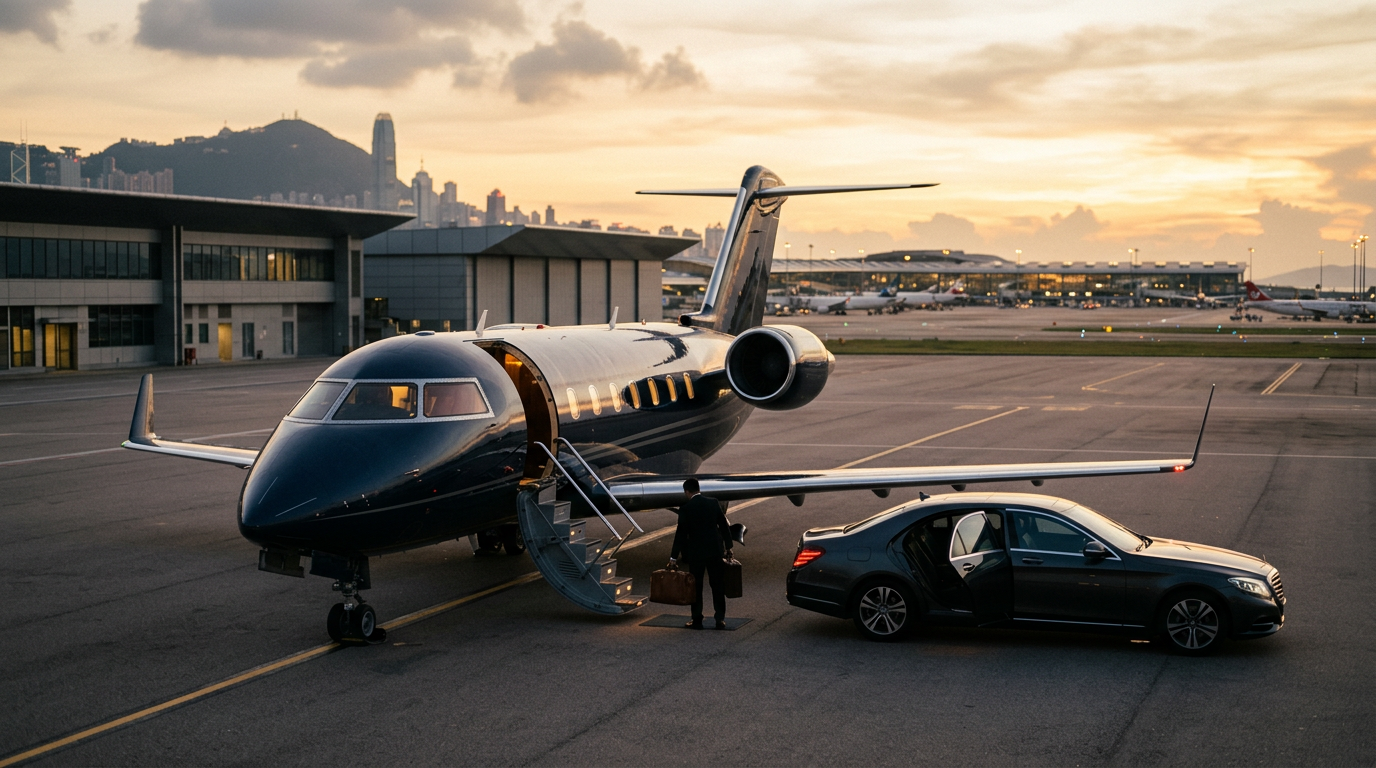
The experience at the Hong Kong Business Aviation Centre is fundamentally different. It is designed around the passenger, not the process. Located separately from the main terminal, the HKBAC is a dedicated facility for private jet travellers. Upon arrival, your handling agent and often the crew are waiting to greet you. Your luggage is taken directly to the aircraft.
Inside the FBO (Fixed-Base Operator), you are guided through a private security and immigration channel. There are no queues, only a quiet and supremely efficient screening that takes mere minutes. You may choose to board immediately or wait briefly in a private lounge. The decision is yours, and the schedule is dictated by your readiness. From the moment your car stops to the moment you are seated on board, the entire process can take as little as 15 to 20 minutes. The aircraft is often cleared for takeoff shortly after the doors are closed.
Time Saved, Opportunities Gained
Consider a flight from Hong Kong to Tokyo. A commercial flight might require leaving your office in Central three and a half hours before takeoff. With a private charter, you could leave just one hour before. This is not merely a convenience; it represents a fundamental shift in how one manages a day. For a short-haul flight on a mid-size jet like a Cessna Citation Latitude to Manila or a Bombardier Challenger 350 to Singapore, the time saved on the ground in Hong Kong can be equivalent to a significant portion of the flight itself.
On long-range journeys to London or New York aboard an aircraft like a Gulfstream G700, this efficiency at the point of departure sets a precedent for the entire trip. It eliminates the friction of travel, preserving energy and focus for the destination. The value of private aviation, therefore, is not simply the luxury of the cabin; it is the powerful gift of time returned to its owner.